

I have learned to be cautious at this time of year. This isn’t some vague paranoia or undue anxiety – I genuinely wonder how many of these autumnal dinner parties I can survive.
When you get a reputation as someone who forages for wild edibles you soon learn to be on your guard when it comes to food with friends. Much like the vegetarian who often finds themselves being given the ‘special’ meal (presented off to the side in that small, rarely- used earthenware dish) – once the host knows that the foraging bloke is coming they seem compelled to hurl themselves at the hedgerow to gather something wild.
I reckon I’ve been presented with something vaguely toxic on at least a dozen occasions now. Some incidents have been relatively mild (Arum leaves sneaking into the wild garlic for the pesto); others more serious (Hemlock mistaken for Hogweed – luckily caught before it entered the house). But what truly concerns me are the mushrooms. As summer fades, I find myself at serious risk…
“Where did you find those…err… mushrooms? Do you have any left, or did you take any photos? Oh they were just the white ones under the tree? The pretty ones? I see… could we have a chat before we eat?”

A History of Mycophobia
The British cultural relationship with mushrooms is a curious one. Historically we have been a pretty mycophobic nation, leaving it to the continental types to head into the woods with baskets. Gathering of wild mushrooms was undoubtedly part of rural life – but mostly at the fringes, and often left to the poorest. There is even a narrative that mushrooms – and all things fungal – were assigned to the Devil by the church.
God himself only deals with trees, flowers and plants it seems.
I’m not sure who handles seaweeds.

Food for Free
By the mid-20th century the practice of eating things found wild in the British landscape was on the wane. Blackberries and hedgerow fruits were still sought out, but knowledge and appetite for the rest was, quite literally, dying out. The resurgence in British wild food awareness can be partly blamed on Richard Mabey’s 1972 book Food For Free which was perfectly timed to land just as the flower-power hippies of the Sixties became the hobbity, permaculture hippies of the Seventies.
Foraging was a natural fit for those wanting to live closer to nature and with less dependence on global business – so samphire, seaweeds and sorrels were all back on the menu. But strangely the foodie zeitgeist mostly ignored mushroom foraging for the next few decades.
Wild Food Celebrities
Sometime in the Nineties mushrooms became an acceptable item to forage once again, with amateur mycologists turning their attention towards the edible species. A new breed of celebrity chef began to pick up on the availability of wild British mushrooms, championing them on TV show and in newsprint alike.
European culinary influences, combined with the rise of the internet and social media, propelled mushroom foraging into the mainstream. Today, a quick look at fungal Instagram or TikTok shows a world of young, glamorous influencers vying for global attention. Mushroom foraging has essentially become vegan deer stalking – but much more appealing to the social media algorithms.
And while it’s acceptable to stalk mushrooms while wearing a floaty boho dress – I’ve tried doing that with the deer, and it’s difficult to get into the high seat with my dignity intact.

The Spectrum of Edibility
There are around 14,000 species of non-microscopic fungi to be found in Europe – and I think there are around 12 that are worth properly hunting down. Not 12,000 – 12. The really interesting ones sit at either end of the spectrum of edibility – at one end you have ‘goes well with butter and some garlic’, at the other you have ‘long, painful death that will be written about in the newspapers’.
Chanterelles, Porcini, Field mushrooms, Giant Puffballs all sit at the butter + garlic end – and things like Destroying Angel, Death Cap and Funeral Bell sit at the other extreme. Most of what resides in the middle is inedible – but inedible does not necessarily mean lethal.
The truly deadly species are available out there in the British countryside every year – but so are Hemlock, Deadly Nightshade, Foxglove, Yew trees and a good few other deadly plants and flowers. We manage to get through life without accidentally nibbling on those, so how come the troublesome mushroom species keep ending up in the stroganoff?

Identification is hard work
Proper, solid identification is necessary for all wild harvesting – from sloes to stinging nettles. But it is much harder to achieve that when it comes to mushrooms.
For one thing, the mushroom we see above ground is just the fruiting body – the rest of the organism is in the soil or decaying wood, a web of microscopic mycelial fibres spread across the landscape. Plants and trees helpfully show you their flowers, leaves and branches – all aiding with the identification of the fruits that eventually appear.
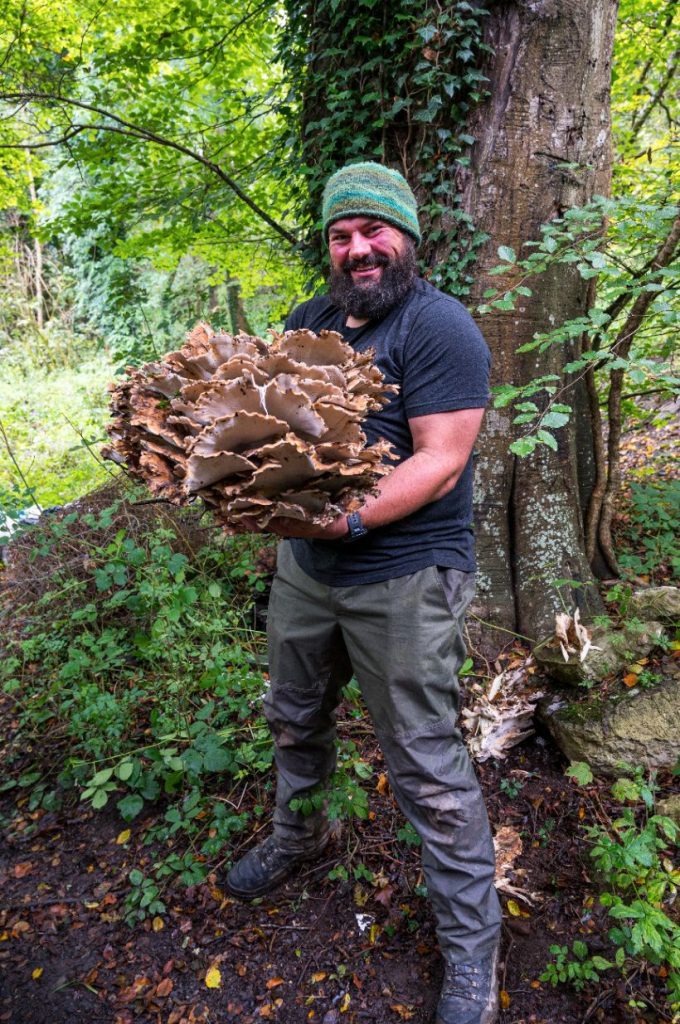
Secondly you have the breakneck pace at which mushroom fruiting bodies can develop. Their cells develop by expansion, not division and they can erupt out in a matter of hours. They will grow at a rate of 4% every hour (or roughly double in size every 24 hours) through a process known as turgor – internal hydrostatic pressure within the cell. Many species will go from looking like a jellybean to a full stem-and-cap formation within a short weekend, and the shape, colour, and even scent will change just as swiftly and dramatically.
This is why you can take the dogs out one morning and feel like your meadow has been invaded overnight by an alien species – those mushrooms were there yesterday, you just didn’t notice them hidden away in the long grass.
Lookalikes and Distractions
Mushroom identification is tricky for even the most diligent and learned forager – often that specimen in front of you looks nothing like the one in your guidebook or in the app, you were just a few hours early or late in stumbling across it. This is why those who forage for mushrooms tend to target certain species or locations and just discount the rest – they are looking for something specific and not just trying to identify every single thing that they come across.
As for friends eager to impress with their foraging skills, the issue is usually a lack of realisation about how tricky the task can be. To them, those white mushrooms at the edge of the meadow are just Field mushrooms (Agaricus campestris) – their family has been eating them for generations and no harm has befallen them, so why bother now? They may be entirely unaware of the cousin Yellow Stainer (Agaricus xanthodermus) that can cause great gastrointestinal distress, or the broadly-similar Amanita virosa (deadly) or Amanita phalloides (incredibly deadly).
There have been at least two occasions now where I have found Agaricus xanthodermus in the kitchen of friends, each time them asking me why these particular field mushrooms smell so strongly of iodine.

Don’t be put off.
Mushroom foraging isn’t inherently riskier than any other type of wild harvest, but that cultural inversion from a national mycophobia to mycophilia over the past 30 years has led to a few issues. While it’s great that people are no longer afraid of mushrooms, there’s a tendency to overlook the potential risks and to underestimate how tricky identification of mushrooms can be.
If you’re planning on adding wild mushrooms to your cuisine this autumn then make sure you put a good amount of effort into identifying what you’re picking – including checking it against the lookalike species. You could also leave a specimen or two for re-identification if it somehow has all gone wrong, and you need to tell the doctor what you have eaten.
Please do still invite me over for dinner. I am clean, tidy (ish) and often bring weird and wonderful homemade alcohols with me – but if you’re serving wild mushrooms for the first time I might ask to see your homework before I commit to that first forkful.
